Wal-Mart used to list as a fact the figure that, at one recent point, 74% of WM hourly associates worked full time. All of a sudden, this number has disappeared from several places on the "Do You Know" section of walmartfacts.com. However, "currently 74 percent of Wal-Mart’s hourly store associates in the United States work full-time" still appears on the careers section. (UPDATE: The page has been modified, and now reads " the majority of Wal-Mart’s hourly store associates in the United States work full-time"; below is a screenshot I took this morning when I initially posted, just in case WM changed its information).
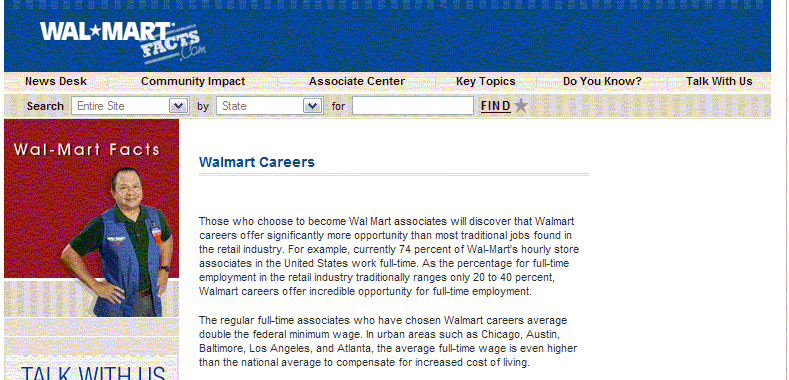
I have relied on the 74% figure in the past, but I will not anymore. And I do not like the implications of this silent change. Now, a figure like this is bound to change over time, especially as temporary hiring occurs during the shopping season, but instead of 74%, or a range over the past few years, Wal-Mart now writes that "The majority of Wal-Mart's hourly store associates in the U.S. work full-time". That could be a considerable difference, or it could just be bad phrasing, and I'm surprised the anti-WM folks aren't up in arms -- yet.
Posted by Kevin on April, 20 2005 at 06:46 AM
SamK wrote:Wal-Mart also used to list the percent of their workers that use the company health plan at 46% on walmartfacts.com, overnight about 2 weeks ago that figure jumped to 56%. I'm kicking myself for not taking a screenshot of the previous page, and I've been searching for evidence to support this other "silent change".
-- April 21, 2005 12:13 PM ∞
couler wrote:change may have come with the change of what walmart considers full time. as of jan 2001. prior to jan 01 full time hours were 28 per week as of jan1 01 full time hours are 36 ( or was it 34) however those that were hired prior to jan 1 01 are "grandfathered" in at 28. also in regards to the whole insurance issue walmart tends to be a second income for employees (or the household) and a lot of these employees already have health insurance from the spouses company or their primary job.
-- April 26, 2005 10:08 AM ∞
Roger Hardin wrote:Sure, but a lot of companies are looking at Wal-Mart and saying that it's not competitive to offer affordable health insurance anymore, so they're reducing coverage and shifting costs to employees. The trend is for less and less coverage from your employer.
On one hand, Wal-Mart brags about creating fantastic career opportunities for its associates, but when anyone scrutinizes whose jobs, it reverts to: "hey, these are just piddly little retail jobs for housewives and teenagers. Nobody really thinks these are good jobs."
-- April 26, 2005 01:31 PM ∞
Kevin Brancato wrote:Roger,
Is there hard evidence that the AMOUNT paid by employers for employees health insurance is decreasing?
They might very well be "reducing coverage" and "shifting costs" AND paying more than they used to...
-- April 26, 2005 01:41 PM ∞
Roger Hardin wrote:Employers are not just scaling back health benefits, more and more are ending coverage altogether.
According to the Kaiser Family Foundation, there were "at least 5 million fewer jobs providing health insurance in 2004 than 2001."
One can assume that other employers see Wal-Mart getting away with making taxpayers pick up the check for providing care to workers through Medicaid and various state plans for workers (TennCare, PeachCare, etc.) and decide to follow the same model.
In an environment where more employers aren't offering ANY coverage, it's increasingly irresponsible for Wal-Mart to expect workers to get coverage through a spouse or parent. That kind of family and dependent coverage is rabidly shrinking.
-- April 26, 2005 03:48 PM ∞
Roger Hardin wrote:Employers are not just scaling back health benefits, more and more are ending coverage altogether.
According to the Kaiser Family Foundation, there were "at least 5 million fewer jobs providing health insurance in 2004 than 2001."
One can assume that other employers see Wal-Mart getting away with making taxpayers pick up the check for providing care to workers through Medicaid and various state plans for workers (TennCare, PeachCare, etc.) and decide to follow the same model.
In an environment where more employers aren't offering ANY coverage, it's increasingly irresponsible for Wal-Mart to expect workers to get coverage through a spouse or parent. That kind of family and dependent coverage is rabidly shrinking.
-- April 26, 2005 03:50 PM ∞
Roger Hardin wrote:Employers are not just scaling back health benefits, more and more are ending coverage altogether.
According to the Kaiser Family Foundation, there were "at least 5 million fewer jobs providing health insurance in 2004 than 2001."
One can assume that other employers see Wal-Mart getting away with making taxpayers pick up the check for providing care to workers through Medicaid and various state plans for workers (TennCare, PeachCare, etc.) and decide to follow the same model.
In an environment where more employers aren't offering ANY coverage, it's increasingly irresponsible for Wal-Mart to expect workers to get coverage through a spouse or parent. That kind of family and dependent coverage is rabidly shrinking.
-- April 26, 2005 04:00 PM ∞
Kevin Brancato wrote:OK, I'll ask more directly. Aren't firms paying more in absolute real dollars per person for healthcare premia than they used to? The share family coverage premia paid by the employee is the same as it was in 1988 and 1996, and has been highly variable for single coverage. Hence, both employees and employers are paying more for coverage. Except for small firms, many of which have chosen to not offer coverage, probably since what they can offer is little better than what an employee can get on his own.
The scare figure of 5 million is taken from this table. Note that if you go back to 2000, only 2.5 million fewer jobs are providing health insurance, and the entire drop is seemingly due to less coverage in small business, which is of course driven by the higher cost TO THE EMPLOYER of providing such health insurance.
In fact, if you go back to 1999 (see slide 17 of this powerpoint presentation, the total percentage then (62%) is not statistically different from that in 2004 (61%).
-- April 26, 2005 04:36 PM ∞
Roger Hardin wrote:You're fixating on an irrelevant point.
Wal-Mart isn't saying that the rising overall cost of care is why it offers such skimpy benefits -- Wal-Mart says the quality of its health coverae often doesn't matter because these are just lousy retail jobs and it expects many of its workers to get care from a spouse or parent. But other employers are offering less and less coverage for family members -- are you seriously arguing otherwise? (Higher cots aren't the only factor in small businesses making the decision to reduce coverage: competitive pressure from Wal-Mart is certainly a factor in small businesses reducing or ending health coverage.)
You seem eager to change the subject to the overall rise in the cost of carecare. That's certainly true, but when Wal-Mart and other employers leave so many workers without coverage this itself becomes a driver of those costs. Uncovered workers put off going to get care because they know how expensive it would be to get treatment without insurance. Unfortunately, putting off care often means letting a disease or injury get much worse, ultimately driving up the cost of treatment. Any hospital exectutive or ER triage nurse will confirm this many, many times over.
And keep in mind that rising healt costs are the only row on the spreadsheet. For the past several years corporate profits have recovered significantly, productivity is surging, but wage growth is flat or even negative. Many employers are choosing to shift costs to workers because they can (with a 92 percent nonunion workforce, who's going to complain?), not because they must.
-- April 26, 2005 05:07 PM ∞
Roger Hardin wrote:To be clear: I meant to write that health costs are NOT the only row on the spreadsheet.
The macro trend is that American workers are struggling to get access to health care. Health costs are going up, but employers would likely be shifting costs even if they weren't because they it is a good way to increase profits. The vast majority of American workers can't say or do anyting about these cost shifts because they don't have an organized voice with their employer. (You can go in and bitch to your immediate supervisor about the benefits, but she doesn't have any power over that sort of thing anyway. Those decisions are made back in Bentonville (or wherever.)
-- April 26, 2005 07:37 PM ∞
JR wrote:Kevin:
I so owe you an apology. I was just writing today how good you were at finding obscure stuff, but your "best and worst" label about Wal-Mart was false advertising.
You're still a free-market conservative, but you are a FAIR free-market conservative.
JR
-- April 26, 2005 08:35 PM ∞
Kevin Brancato wrote:JR,
I hit 'em hard when I think they deserve it, and changing "facts" without so much as an explanatory note crosses the line. It's just absolutely dumb and inexcusable. Maybe that's a different standard than you and others apply, but it makes sense to me.
And don't apologize to me, just link with a note that you've found at least one "worst". It would be a lot more than WM did.
Besides, if you're going to call me names, I prefer "free-market fascist", which has the virtue of not lumping me in with "conservatives" (I support gay marriage , hate want to eliminate all protective tariffs!), but has the vice of viscously impugning the Brancato family's Italian heritage.
-- April 26, 2005 09:11 PM ∞
Kevin Brancato wrote:Roger,
I'm working on a reply to you; you've made substantive arguments, and I'd like to make a comprehensive and thorough reply, using the best available data.
I should be done with it tomorrow afternoon. Thank you for commenting.
-- April 26, 2005 09:41 PM ∞
Roger Hardin wrote:Take your time. My guess is that you're working on a long post singing the praises of health savings accounts, telling the fairy tale that health care would be fixed if we just made everybody pay for it up front.
Nobody who studies health care quality and access believes any of that, although "you're on your own health care" is very popular among economic libertarian ideologues and is increasingly being touted by large companies like Wal-Mart. "Consumer driven" and "choice" are euphemisms for "health care that is rationed by the size of patients' checking accounts."
-- April 27, 2005 04:40 PM ∞
Keivn Brancato wrote:Actually, Roger I was trying to verify the current situation in profits, productivity, wages, and most of all health insurance markets. Your vision of the latter is not supported by the evidence.
Next time, a little goodwill won't hurt.
-----
When you wrote that 5 million fewer jobs offered health insurance, I found a statistic from Kaiser that contradicted their own claim. I don't think that is fixation; that's just finding out that judging from a "peak" is not generally useful.
-----
You wrote that "Employers are... scaling back health benefits". I noted that both employers and employees are paying more. They are not "scaling back", meaning paying a smaller real amount than they used to. I have seen no evidence of employers "shifting" costs they used to pay onto their employees. Please provide links to your evidence.
You also insisted that "more and more [employers] are ending coverage altogether." No, in fact the percentage of firms offering coverage is higher than in the mid 1990s and lower than in 2001-2. I'm not going to engage in baseline-year debate.
I noted (and provided a link data to back up my claim), that the percentage of workers covered by employer-provided healthcare benefits as in both covering and non-covering firms has not changed much since 1999, except for small businesses, which have seen a percentage drop.
You also wrote that "employers are offering less and less coverage for family members -- are you seriously arguing otherwise". No, Kaiser is. Please look at the data, and rebut it.
I cannot find solid evidence of a long term trend that employers are offering less and less coverage for family members. If you can, please link to it. It seems to me that what's happening is that cost increases are being borne by both employer and employee, and small firms are being hit hardest, and some are offering less coverage.
Kaiser claims that the share of premia paid by firms for family coverage is about the same for the past 15 years. A greater share of firms are paying from 50-75% of family share premia; a lesser share of firms is paying less than 50% or exactly 100%, though 41% of firms are at least somewhat likely to increase the employee's share of family premia in the next two years. Overall, more firms are reporting that the share of covered workers enrolled in family plans has increased than are reporting the share has decreased.
In addition, the average waiting period for coverage has changed little since 1999. The number of plans available to employees is roughly the same. The deductibles on single and family plans have been rising at a fast clip. HMO doctor visit co-pays are increasing, and now average $15. The average copay for drugs has also been increasing, although the use of mail-order discount is becoming almost universal.
-----
Roger, I am "eager" to understand you. You write: "For the past several years corporate profits have recovered significantly," as if profits were somehow out of line, and as if profits were more important than labor markets in the determination of wages and benefits. You write that "wage growth is flat or even negative", which makes sense since compensation increases are being paid in the form of larger employer health insurance contributions.
"Many employers are choosing to shift costs to workers" Where is your evidence for this? No, employers are bearing greater cost. So are employees, and yes employees are bearing a greater increase, especially when you add in deductible changes and the like. That is not a cost "shift" in any reasonable sense of the word.
"with a 92 percent nonunion workforce, who's going to complain?" I complain. The idea that few complain or shift jobs without unions is simply unjustified. You completely underestimate the role of markets in employee-employer relations. Why does Wal-Mart pay $10+ an hour in cities but $7 elsewhere? Because it likes those people better? No, because the alternative opportunities for city employees pay more, not because of any less "power" WM has over them.
-----
I simply do not see how getting employers to pay more for their employees healthcare is a long-term solution to anything, including battling higher healthcare costs.
-- April 27, 2005 05:00 PM ∞
Pete wrote:I think we all need a hobby. Come on gang hop in the minivan and let's run to wally world for some models and paint! Seriously, as much as effort you folks put in to watching/slamming this corporation, you could get a job with corporate. Who cares if they employ more PT workers that FT? How does this affect you personally? Additionally, why are you concerned with their employee's health benefits? I am just curious...please explain. Why aren't we all posting dirt on GM, Exon-Mobile, IBM or evil, evil Starbucks? Side note: Kevin, the data most likely jumped so quickly because the website probably isn't updated daily with those stats. When the next census results come out...am I to believe that our population grew by 20 million overnight? Gang, I think this issue has been "played out" as the kids would say...go outside and golf or somesuch.
-- April 28, 2005 04:14 PM ∞
Roger Hardin wrote:Kevin,
Sorry for the delay in responding. I typed out a long reply last week but must have hit preview instead of post, because obviously it's not here. And you're right -- my post above is a little snarky. No need for that, sorry.
I don't have time to redo that entire response, so I'll try to cut to the point:
The problem with using this Kaiser data is that it only goes back to the 1990s, when the health system was already in trouble in terms of cost. If we went futher back we'd find that much fewer workers paid premiums, copays, or deductibles.
You argue that workers aren't really paying more. I don't think that squares with most people's experiences.
I lot of business people have argued that the problem is that workers don't realize how expensive helath care is because it's been paid for by their employer. I don't have data, but i think i have a decent anecdote showing how this doesn't happen anymore.
I have a friend who does market research -- focus groups, mostly. She told me recently that it is astonishing how much people are concerned about health costs, and it's the most dramatic change she's seen in consumers' attitudes over the past five years. As little as a few years ago most people didn't really know how much their monthly costs were -- now nearly everyone knows them to the penny. And the vast majority of middle class consumers she researches worry about a layoff not so much because of the lost income but because of the lost insurance. COBRA is so expensive it's nearly useless.
So, obviously we've got to tackle the rising costs overall. Many free market ideologues like yourself want to just end any employer role in health care at all, which is what Wal-mart is starting to quietly hint at.
That would be fine in we could move to a system that creates a large pool of insured people to share the risks and costs -- the kinds of systems that all of our major trading partners have. These systems cost much, much less per capita and produce higher quality outcomes in terms of patient outcomes and overall population health.
But that's not what you guys want -- you guys want an individualized system that would be a disaster for middle income people with chronic health conditions and most working people who make what a Wal-Mart cashier and many W-M customrers make. As I said earlier, we would ration care based on the size of a patient's checking account. (We already do this with the millions of Americans who don't have insurance -- they get very lousy health care because they can't afford coverage.)
The American business community fought tooth and nail to prevent reforms that would have decoupled health care from employment. In doing so, they took on some of the responsiblity for fixing this mess. Walking away from the problem -- which is what health savings accounts would be for employers -- is a abdication of their responsiblity.
-- May 1, 2005 06:49 PM ∞